Polymarket odds explained in one line: a Polymarket price is the cost of a share that pays $1 if the outcome happens and $0 if it does not, so a share trading at 62¢ means the market puts the chance at about 62%. The odds you see are simply share prices, and your payout is your number of shares times $1.
This guide goes deeper into reading those prices: how they move, how to convert them to decimal odds, how to work out exactly how much you can win, and when a price is worth paying. If you have not set up Predictions in Thor yet, start with the Polymarket Telegram bot guide, which covers setup and adding cash.
How Polymarket Prices Work
Polymarket is a market, not a bookmaker. Nobody sets the odds for you. Traders buy and sell shares in each outcome, and the price is wherever buyers and sellers meet. When news makes an outcome more likely, people buy Yes, and the price rises. When it makes it less likely, people sell, and the price falls.
Because a winning share always pays exactly $1, the price in cents reads directly as a percentage:
- A Yes share at 62¢ means the market thinks there is about a 62% chance.
- A Yes share at 6¢ means about a 6% chance.
- A No share at 39¢ means the market thinks the outcome has about a 39% chance of not happening.
That number is the crowd's estimate, not a fact. It can be wrong, and it changes every time someone trades.
Reading an event in Thor
 Thor Trading Bot
 Thor Trading Bot
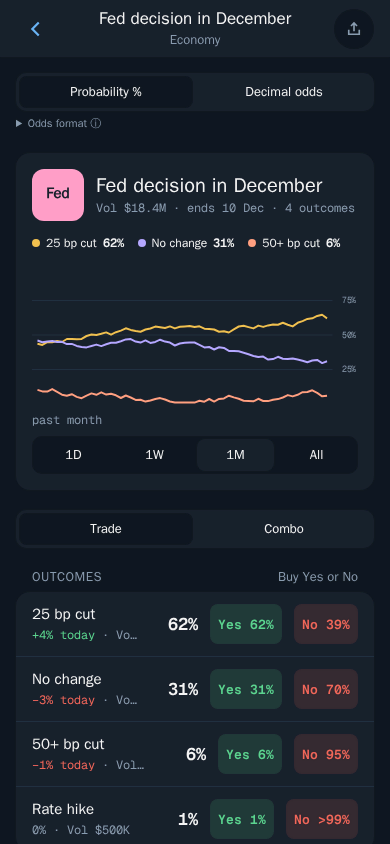
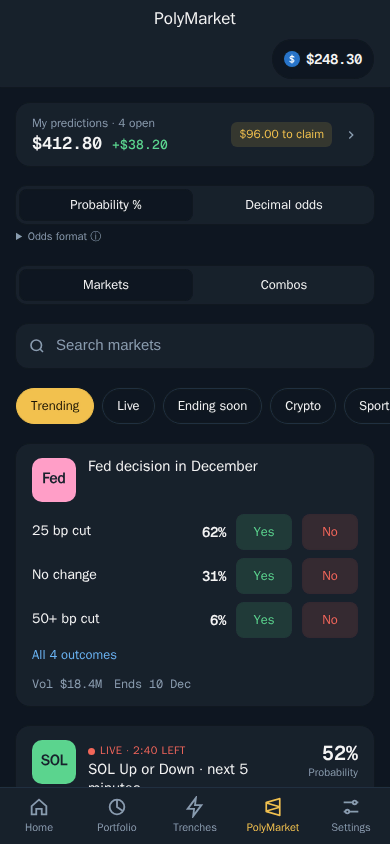
In the Thor Mini App, open Home, then Predictions. Each event card lists its outcomes with a percentage next to each one. Some events have just Yes or No. Others, like the Fed decision example above, have several outcomes, and each outcome has its own Yes and No shares.
Open an event to see a chart of how each outcome's price has moved over time, plus the current Yes and No price for every outcome. A rising line means the market has grown more confident in that outcome.
Why Yes and No do not add up to exactly 100%
In the example above, Yes on "25 bp cut" shows 62% and No shows 39%, which adds up to 101%. That extra point is the spread: the gap between the best price someone will sell to you at and the best price someone will buy from you at. Thin markets with little trading usually have wider spreads, so you pay a little more to get in and get a little less when you sell.
Probability vs Decimal Odds
Thor lets you switch the display between Probability % and Decimal odds at the top of the Predictions screens. Both show the same price; they just express it differently.
- Probability is the share price as a percentage chance.
- Decimal odds are how much one dollar returns in total if you win, including your stake. The formula is 1 divided by the share price in dollars.
| Share price | Probability | Decimal odds | Return on $1 if right |
|---|---|---|---|
| 5¢ | 5% | 20.00 | $20.00 |
| 10¢ | 10% | 10.00 | $10.00 |
| 25¢ | 25% | 4.00 | $4.00 |
| 50¢ | 50% | 2.00 | $2.00 |
| 62¢ | 62% | 1.61 | $1.61 |
| 80¢ | 80% | 1.25 | $1.25 |
| 95¢ | 95% | 1.05 | $1.05 |
These are worked examples before fees, not live prices. If you come from sports betting, decimal odds will feel familiar. If you think in chances, probability is quicker to read. Pick whichever you read faster; it does not change what you pay.
How Much Can I Win on Polymarket?
The maths is the same for every market:
- Shares = your stake divided by the share price.
- Payout if right = shares times $1.
- Profit if right = payout minus your stake and fees.
- If wrong, the shares pay $0 and you lose the stake.
Here is what a $50 stake does at different prices, before fees:
| Price | Shares | Payout if right | Profit if right | Loss if wrong |
|---|---|---|---|---|
| 10¢ | 500 | $500 | $450 | $50 |
| 25¢ | 200 | $200 | $150 | $50 |
| 50¢ | 100 | $100 | $50 | $50 |
| 80¢ | 62.5 | $62.50 | $12.50 | $50 |
| 95¢ | about 52.6 | about $52.60 | about $2.60 | $50 |
The pattern is the whole point: cheap shares pay more but win less often; expensive shares win more often but pay little. A 95¢ share risks $50 to make under $3.
What the ticket shows you
You do not have to do the maths yourself. Thor puts it on the ticket before you confirm (see Place a prediction).
- Open an event and tap the outcome you want.
- Pick Yes or No. The button shows the current price.
- Tap an amount such as $50, or type your own.
- Read the summary: probability, average price, shares, payout if right, profit if right, the Polymarket fee, the Thor fee and the maximum price.
- Tap Buy to confirm.
Thor Trading Bot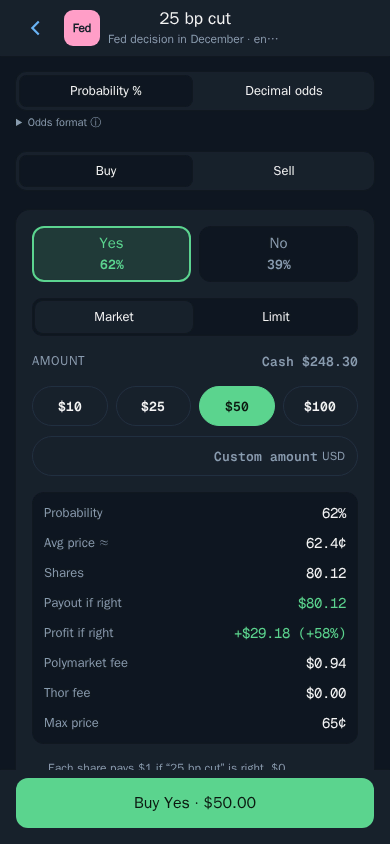
In the example ticket, $50 of Yes at about 62¢ buys about 80 shares with a payout of about $80 if right. The average price can sit slightly above the headline price because a larger order may fill against several sellers at slightly different prices. The max price is the most the order will pay per share.
Polymarket Payout: When and How You Get Paid
A market pays out when it resolves. At that point every winning share is worth $1 and every losing share is worth $0. Polymarket decides how each market resolves, using the rules written for that market. Thor does not control or guarantee any outcome or payout, so read the rules before you buy and make sure you know exactly what counts as Yes.
After a market resolves in your favour, open My predictions and claim your winnings. You also do not have to wait for resolution: you can sell your shares at the current price any time before the market resolves (see Your predictions and winnings). Selling early locks in a gain or cuts a loss at whatever the market will pay now.
For step-by-step claiming, cancelling orders and withdrawing, see Polymarket limit orders, claims and withdrawals.
Is the Price Right? Thinking in Expected Value
The price tells you what the crowd thinks. Your edge only exists if you think the crowd is wrong.
- If you think an outcome has a 70% chance and Yes trades at 62¢, the price looks cheap to you.
- If you think it has a 55% chance, the same 62¢ looks expensive, and No might be the better side.
- If your estimate matches the price, there is no edge, and fees and the spread make it a slightly losing bet.
A simple habit: before you buy, write down your own probability, then compare it with the price. Use a limit order when you want a better price than the market is offering right now.
Fees on Polymarket Predictions in Thor
| Fee | Amount |
|---|---|
| Thor fee on predictions | $0 today |
| Polymarket fee | Polymarket's own fee, shown on the ticket |
Thor's fee on predictions is shown on the ticket and is $0 today. Polymarket's own fee still applies and is part of your cost, so a thin edge can disappear once fees are counted. Prediction trades do not earn cashback or referral rewards, and the Thor subscription does not cover predictions or Polymarket fees.
The subscription is built for spot trading: $100 for 30 days cuts Thor's 0.5% fee on spot trades and bridging to 0% on Solana and every EVM chain, and it breaks even at $20,000 of spot volume in 30 days. That 0.5% is already half the 1% many Telegram trading bots charge. See Fees and Subscription.
Warning: Prediction market shares can go to $0. A high probability is not a guarantee, and markets can resolve in ways you did not expect. Only use money you can afford to lose. Prediction markets are blocked in some countries, and in others you can only close positions, withdraw and claim.
Put It Into Practice
Now that the numbers make sense, open Thor on Telegram, go to Home, then Predictions, and look at a few events with the display set to the format you prefer. Your predictions cash is held as pUSD, a dollar-backed balance; the USDC trading bot guide explains how dollar balances work across Thor. If you also want to trade price moves with leverage, read the Hyperliquid perps guide.
Frequently asked questions
What does 62% mean on Polymarket?
It means a Yes share costs about 62 cents. Since each winning share pays $1, the market as a whole is pricing the outcome at roughly a 62% chance of happening.
How do I convert Polymarket prices to decimal odds?
Divide 1 by the share price in dollars. A 62 cent share is 1 divided by 0.62, or about 1.61 in decimal odds. In Thor you can switch the display between Probability % and Decimal odds at the top of the screen.
How much can I win on Polymarket?
Divide your stake by the share price to get your shares, and each winning share pays $1. A $50 stake at 25 cents buys 200 shares that pay $200 if right, before fees. The ticket in Thor shows your exact shares, payout and profit before you confirm.
Why do Yes and No prices not add up to exactly 100%?
Yes and No are traded separately, so there is a small gap between the price buyers pay and the price sellers get. That gap is the spread, and it is why Yes at 62% and No at 39% can add up to slightly more than 100%.
When do I get my Polymarket payout?
When the market resolves. Winning shares are worth $1 each and you claim them in My predictions. Polymarket decides how each market resolves, not Thor.
Is a cheap share a better bet?
Not by itself. A 10 cent share pays 10 times your stake if right, but the market thinks it happens only about 10% of the time. A bet is only worth it if you think the real chance is higher than the price.
Step-by-step in the Docs
- Predictions: get started: Trade on real-world events.
- Place a prediction: Buy Yes or No at the market or your own price.
- Your predictions and winnings: Sell early or claim when a market resolves.